Showing posts with label Books and plays. Show all posts

19 May 2012

The Heretic

Well, MTC's production is a bit verbose and repetitious at times, but Noni Hazlehurst and the cast turn on a good performance in The Heretic.   Hazlehurst's down-to-earth character is a stark contrast to the others, who are over-the-top and often frantic to the point of being almost absurd at times. The theme of the need for scientific rigour and the danger of being compromised in the quest for sponsorship is interwoven with inter-generational challenges and the seriousness of youth (especially, how to relate your strongly held principles with the requirement to exist on a day-to-day basis).

Even though there are a few twists and turns, it's a bit drawn-out, and the coarse language is at times (in my view) overdone (but I would say that, wouldn't I?)  There's some good humour.  It's often pretty black, and just occasionally you have to listen to discern it through the slight traces of Yorkshire dialect that are incorporated.

This is a satirical play, taking a swipe at just about everyone, not a scientific paper.   So, I was amused at some of the self-righteous commentary on the internet (such as https://theconversation.edu.au/heretic-melbourne-theatre-company-runs-with-the-goons-6871) that severely criticise MTC for daring to put on The Heretic.   I fear that the writers of such commentaries have missed the point.  Perhaps they just serve to illustrate it?

Since first posting the above, I discover that Quadrant, too, has commented on the issue.  In the interests of completeness (or whatever), here's the link:  http://www.quadrant.org.au/blogs/doomed-planet/2012/05/on-with-the-play

11 May 2012

Edwardian Train Travel

"Travelling by Train in the Edwardian Age" by Philip Unwin takes us back to the glory days of train travel. I picked up a copy in the 2nd hand book shop at Rutherglen (a great shop, by the way), and then became absorbed in the descriptions and photos.

The author records a number of boyhood memories (the book was published in 1979), but the book is far more than this.   While some of the descriptions are a little "rose-coloured" (for example, the chapter on steam engines!), there are also a number of down-to-earth observations such as the long hours worked and the strict rules that had to be obeyed.  The book concludes with the words, "Edwardian trains, like the great sailing ships, were costly and exacting in human terms, but to travel in them had its magnificence and it is good to remember their finest qualities".

However, the cost of travel was (very broadly speaking) not greatly different to what it is today.  Today's advance purchase fares seem to be somewhat cheaper in real terms, but unrestricted fares appear to be more expensive.  Travellers in 1923 didn't have to worry about advance purchase deals, and according to my copy of the ABC Railway Guide of 1923 (reprinted in 1986), the 3rd class fare from London to Brighton was 6s 4d (1st class was 10s 6d).  Using http://safalra.com/other/historical-uk-inflation-price-conversion/, it seems that prices since then have multiplied 45 times, which means that this fare would be something over £14 in today's terms.  Today's fare structure is more complex, and fares for this trip range from £10 (or even cheaper) for advance purchase tickets to £24 or thereabouts (or £36 for first class).
.  

04 May 2012

W L Baillieu

The current issue of Quadrant magazine has a review by Trevor Sykes of Peter Yule's new book, William Lawrence Baillieu: Founder of Australia's Greatest Business Empire*.  The title is based on the fact that the numerous Collins House enterprises (including the zinc plant at Risdon and the lead smelter at Port Pirie) were built on profits from Broken Hill, and WLB had interests in many of them.

The book is apparently the first published biography of WLB (although there are apparently two unpublished biographies).  I must try and get hold of a copy of it.

Of course, WLB is important in the context of the history of mining in Australia.  For example, he's mentioned in  W. S. Robinson's fascinating memoirs (which WSR himself wrote but which were edited by Geoffrey Blainey after his death), entitled If I Remember Rightly  (published in 1967), as well as in Geoffrey Blainey's important work, The Rush that Never Ended. Both of these works refer to WLB's involvement in the development of the floatation process which was a significant metallurgical break-through in the early 1900s, enabling the  great dumps of tailings at Broken Hill to be treated.    These were rich in zinc but defied the traditional treatment processes.  As well as being involved with mines, WLB was involved in syndicates that bought up tailings dumps cheaply and then processed them, which enabled him to make a fortune.

WLB entered Victorian state politics and rose to become Minister of Public Works and Health. He continued to foster his business and media interests throughout his life, and by the time he retired, WLB was director of the Herald and Weekly Times, the Electrolytic Zinc Company, the Dunlop Rubber Company, and Carlton and United Breweries.  He was also involved in banking and in the early formation of Victoria's electricity industry.  He died in 1936.

Although he was a philanthropist, he was not always noble-hearted.   Apparently he withheld substantial assets from his creditors when he had to settle with them following the land bust in the 1890s, and was in a position to buy properties at distressed prices when the market bottomed.   His broking firm E L & C Baillieu was a market maker in shares of the Collins House companies, supporting the prices when they were low and unloading them when they were high.   Such action today would give rise to suggestions of insider trading.   And it is said that his shares in the Outtrim coal mine in New South Wales benefited from glowing reports in the Melbourne Herald, where he was a director.  Standards were different in those days!

Nevertheless, the mines with which he was involved and the downstream industries that they spawned under WLB's leadership contributed greatly to Australia's economic well-being.   Comparisons (if any) with Gina Rinehart had best wait for another day.

* - this is the title given in Quadrant.  I notice that a slightly different title is mentioned on the internet.


01 May 2012

Australia Day - the play

MTC's production of Australia Day is certainly funny - if predictable.   It puts together a number of our cultural stereotypes in a country-town setting, including a member of the CWA, an ambitious Liberal mayor, a Greens councillor originally from the city and an Australian-born Vietnamese teacher. 

The interactions are pretty much as you would expect.   In fact, a good part of the humour derives from the clichés and the familiarity of it all coupled with the absence of political correctness and the holding up for examination of our pre-conceptions.   It's all very much in the "here and now", including even a Peter Slipper joke.   There are a couple of unexpected turns as the characters develop (although on reflection, perhaps even these might have been predicted by some) and one or two issues of substance but there's no complexity.  It's an enjoyable but not really challenging night out - and there's nothing wrong with that!

[EDIT - since posting the above, I notice that one of the reviews said of this play, "There's something to offend just about everyone".    Wish I'd thought of that line!]

We didn't book to see Red, which has also been on at MTC.    Apparently this play, which is said  to consider the "fundamentals of art and what it means to be an artist" is a lot harder going.    One of our acquaintances told me that this was the first ever play where he didn't return after the interval.

14 April 2012

Reflecting on the Byzantine era

I read the epilogue to John Julius Norwich's work, A Short History of Byzantium, with interest.  He reflects on the empire's 1123 years and comments on its strengths:  illiteracy was virtually unknown in the middle and upper classes;   it preserved much of the heritage of Greek and Roman antiquity during dark centuries in the West when lights of learning were almost extinguished; and of course it produced some great art, restricted though it may have been to mainly religious subjects.  
Deesis

He singles out the deesis in the south gallery of St Sophia and the Anastasis in the parecclesion of St Saviour in Chora as being amongst the masterpieces (thanks to Bill, the Church of the Holy Saviour in Chora was already on my "to visit" list).

The Anastasis


Lord Norwich  notes that it has been maintained that the greatness of Byzantium lay in the "Triple Fusion":  that of a Roman body, a Greek mind and an oriental, mystical soul.  Nevertheless, the Byzantines were human, and their follies were many, as were their sins, but he suggests that it is inappropriate to condemn them to obscurity which they have to some extent suffered.

He concludes, in relation to the fall on Constantinople: "That is why five and a half centuries later, throughout the Greek world, Tuesday is still believed to be the unluckiest day of the week;  why the Turkish flag still depicts not a crescent but waning moon, reminding us that the moon was in its last quarter when Constantinople finally fell; and why, excepting only the Great Church of St Sophia itself, it is the Land Walls - broken, battered, but still marching from sea to sea - that stand as the city's grandest and most tragic monument."

09 April 2012

Byzantium History (2)

Having a few hours wired up while under observation in the cardiac unit gave me the opportunity to finish reading John Julius Norwich's Short History of Byzantium.
Lord Norwich displays a most impressive mastery of the details of this era.    The details of various battles and conflicts, the often-complex relationships between the numerous emperors, their families, their allies and their foes, the religious issues and much, much more, all seem to be described.

If there's an issue with his work it's that, if read from cover to cover,  the mass of detail might be thought to obscure some of the events that history would judge as having been really "big".  No doubt this is because things such as the adoption of the Greek as the official language instead of Latin (by Heraclius who ruled from 610 to 641), the Great Schism, the various Crusades and their fates, the taking of Constantinople by the Fourth Crusade (well, along with the Venetians and the Franks) and such can only be truly understood in the context of all the other circumstances that contributed to and led up to these particular events.

Lord Norwich does, understandably, devote reasonable space to the actual fall of Constantinople, although this, too, must be seen in context, as being the inevitable result of a long period of decline.    Geoff has suggested in a comment to a previous entry that I could read The Fall of Constantinople, 1453 by Steven Runciman, so perhaps I'll keep my eye open for that.   I might also come back to Lord Norwich's works (either the Short History or perhaps the individual books in his trilogy) and take them more slowly,  so as to more gradually absorb this lengthy era .

05 April 2012

Tim Fischer's book

Tim Fischer's book Transcontinental Train Odyssey is described on one web-site as, "Train enthusiast and former Deputy Prime Minister of Australia's very personal guide to the great transcontinental railways of the world. Full of colourful anecdotes, descriptions of the greatest stations in the world, as well as enough rail history and technical specifications to satisfy the most ardent trainspotter".

Well, the book certainly does contain a lot of interesting information, especially about interesting trips the author has taken and out-of-the way places he's been.   BUT interposed at regular intervals are expressions such as the trip arranger "had worked closely with our ambassador....",  the "...diplomatic officials who travelled with me..." etc.  True, there also are some anecdotes from his pre-parliamentary days, but it does indeed seem that many of the impressive journeys described were in fact undertaken in the course of parliamentary travels - at taxpayers' expense!  Nice work if you can get it.  In fairness, the book does state that part of the royalties are to be donated to good causes (the Fred Hollows Foundation, Frontier Services, the Royal Flying Doctor Service and "the South Australian government" -- not sure about this one!)

It's also apparent that he had a big role in the decision to build the Alice Springs to Darwin railway.  I guess that deserves to be commended as a "nation-building" exercise, but I wonder about the economic rationality of it, at least in the short term and given that other possible rail improvements may have resulted in a better return.

It does indeed seem that, one way or another, Fischer  has been to a number of interesting parts of the world.    But hardly a mention  of Mongolia!    To overcome this deficiency, here's an image of the trans-Mongolian rail line, alongside the Ulan Bataar rail museum.  

03 April 2012

Byzantium history

We're planning to spend a few days later in the year in Istanbul.  My sister recommended that I read up on the history of the Byzantine empire so that I would appreciate the era that followed the founding by Constantine the Great of the Roman Empire of the East on 11 May 330.  Since I knew very little about this era, this seemed an excellent idea, especially as she lent me the first volume in John Julius Norwich's Byzantine trilogy The Early Centuries.

Well, a few weeks passed, and I hadn't finished the book.  I had absorbed numerous emperors, including a number of Constantines, a Constantius or two, Justinian and others.  Lord Norwich certainly packs it in: all the conquests, defeats, religious arguments, plots, sieges, blindings, mutilations, mutinies, marriages of convenience  - the lot.   But I was only up to the death of Constantine IV in 668 (murdered by an attendant with the soap-dish while he was in the bath).   Part of the problem was that I had to give up reading the book in bed before falling asleep, as it's hard to relax with the thoughts of the massacres of 80,000 troops or the self-inflicted drowning of 2000 attractive maidens or the killing of 30,000 civilians in the Hippodrome (ending the Nika revolt) reeling in your mind.  

But then I found the library had a condensed version of the trilogy (A Short History of Byzantium).   It's still got many of the gory details (such as Pope Martin being thrown into prison with murderers and common criminals and deposed emperor Romanus being paraded for 100 miles or so on a donkey "his eyes gouged out and his face and head alive with worms..."), but it compresses the events a little.  I've recently passed the bit where the Eastern and Western churches finally split, when on 16 July 1054 Pope Leo IX's legation led by Cardinal Humbert purported to excommunicate Patriarch Cerularius, so there's at least there's some hope of getting through the remaining years until the conquest of Constantinople on 19 May 1453.  

How many of the details I'll be able to recall when we get to Istanbul is a different matter!

17 March 2012

Stuff Parisians Like

By way of preparation for our visit in a couple of months time, I was given Olivier Magny's Book, "Stuff Parisians Like".   There's also a website - see
http://www.o-chateau.com/stuff-parisians-like
The book seems to be largely derived from posts on the website (although the book is a little more subtle in its promotion of the author's wine bar!)  And here's a link to the Magny's bio:
http://oliviermagny.com/Bio_Page.html
I read much of the book in an afternoon.   I am certainly no expert on the Parisian (or even the French) mind, but many of the observations seem very perceptive!  Part of this derives from the fact that the author, although himself a Parisian, appears to be able to see the Parisian through non-Parisian eyes.
Apparently Parisians regard themselves as very different from banlieusards and provinciaux.  This is consistent with one of the first things I remember about Paris from 1970-something, on our first trip there.  The tour bus guide (who was English) stated as we entered Paris from le périphéique, that we were entering the "real" Paris, in that for the Parisian, Paris began and ended at le périphéique.
But les étrangers can't criticise Parisians.  Only Parisians can criticise Parisians (and do so freely, apparently).   Only Parisians get it.

27 February 2012

Tribes

If the interval at this MTC production had occurred earlier in the play, I would not have returned (which would have been a first-ever for me).  The first few scenes portray a seemingly dysfunctional family, complete with lots of politically incorrect prejudices and much obscene and offensive language (the latter being, to my mind, greatly overdone).  After this, the play greatly improved, perhaps reaching a particular high-point just before the interval.  No doubt the playwright intends to shock us, and my reaction is probably exactly as the playwright intended.

The play explores the way in which people with disabilities (in this case, deafness inparticular, but schizophrenia comes in as well) relate to society, that is, full integration vs a degree of separateness.   However, the play is full of other themes as well.  For example,  a family may appear dysfunctional, but when the really hard challenges arise, how does it cope?    The ability to communicate an array of emotions and messages using sign language is demonstrated (including by the use of surtitles), even though many of us might regard some of these concepts as only capable of being expressed verbally  (in short, they are expressed differently, but certainly adequately).    The feelings that are involved when a person is aware that they are becoming subject to a disability are exposed (not all that different to the aging process, I guess!)

On the whole, there is much in this play.  However, I remain of the view that the message in the first few scenes could have been communicated just as effectively - in fact, even more effectively - if less confrontational language was used.    In fact, if I recall correctly, there is a line in the play to the effect that a good author doesn't use underlining, as he ought to be able to communicate emphasis without resorting to external aids.  I think the same is probably true in this context.

10 February 2012

Edna Walling


We've stayed at the same house at Lorne for many years, but this year for the first time I noticed that one of the books on the shelves was A Gardner's Log, by Edna Walling. This was first published in 1948, and is a collection of her articles from Australian Home Beautiful. The edition here was actually published in 2003 with a number of fresh photographs (as well as photographs from the intermediate editions, especially the 1985 edition).
The book is blog-like!   Of course Edna Walling is from another era but many of her notes, made in the course of the seasons, are still of interest.   They include suggestions under heading such as “Plants for Rock Gardens and Other Places”, “Garden Steps”, “Plant Hunting”, "April in Victoria" and “Roadside Beauty”. However, under these various headings there is a wealth of information about various plants and associated matters.
Just a few quotes at random: “I …. always feel that the part of a garden near the entrance should give the first sensation of rest to those returning home to those returning home. There is nothing very restful about masses of annuals, conjuring up, as they do, hours of labour, and much expenditure on seed, fertilisers and water.” (These displays, she thinks, should be kept for the rear of the house).
“After the architect and the interior decorator have finished with the client, the garden designer starts the battle of trying to achieve a fitting garden with what is left. The client is still there, but the funds, alas!”
“How to become a Landscape Gardner – Walks into the country provide the best lessons on landscape gardening. Notice how the trees are naturally grouped, how the ground-covering plants grow in drifts of different species round their feet, how boulders help to make up the natural scene, and how little tracks, made by cattle perhaps, wander about in lines that are never straight.” 
"I decided this morning that as there is neither the time nor inclination to trot around holding the hands of those plants that look up at you and gasp. "Water! I can't stand this heat another minute", I would take an inventory of those ground-covering plants that can take it."
"...[Q]uite often ... owners  [of flowering climbers] are puzzled as to manner in which they should be pruned and trained.   It is all very simple, the general rule being the same as for flowering shrubs:   prune immediately after flowering."    

22 January 2012

Summer of the Seventeenth Doll

We recently saw the MTC's current production of the Summer of the Seventeenth Doll.  I saw it years ago  - in fact, it may have been one of the first MTC plays that I ever saw.   I hasten to add, however, that was some time after it was first produced in 1955!
I had forgotten the story line, so I looked at this production through fresh eyes.   To recapitulate, for 16 summers, Roo and Barney have spent their long layoff from the cane-cutting season down in Melbourne having a good time with two Carlton barmaids, Olive and Nancy. But back for their 17th summer, it seems time has finally caught up with them. The play is all about the dawning of this realisation and the ability (or inability) of the different characters to "move on".  
The play is, of course, regarded as a classic (perhaps because it was ground-breaking when it wa first produced), so it may be that my thought that some of the initial scenes could have been slightly tightened up is out of place.  Likewise, it's a little odd that the storyline contains no acknowledgement of the fact that it's hard to envisage that there could have been a period of 17 years in the first half of the 20th century when external circumstances (wars, depression etc) would not have brought change to the lives of cane cutters, barmaids and boarding house owners.  
In places, there's some great acting in this production,  even though both Sue and I commented at the first interval that initially we had to strain our ears to decode the 1950s Australian accents!

14 December 2011

The Importance of being Earnest

One reviewer says that Oscar Wilde's most delightful play is "still fresh after 115 years".    I read somewhere that it's one of the funniest things ever written. Well, we saw this a little while back and thought Melbourne Theatre Company's production was great.  Of course, the language and wit are Oscar Wilde's, but modern audiences still enjoy this take on Victorian-era manners, especially when the production is as good as this one.  The reviews speak highly of Geoffrey Rush's performance as Lady Bracknell, but he was strongly supported by the entire cast.  In my opinion, Bob Hornery's  role of both butlers deserves particular mention.
The performance is in the Sumner Theatre, which is smaller than the Playhouse, and I read that the season is virtually sold-out.  Perhaps because so much depends on the facial expressions and other details (such as the consumption of cucumber sandwiches and muffins!), the smaller venue was considered to be more appropriate in that it enables the audience to appreciate some of the finer points.

30 November 2011

The Picador Book of Crime Writing

I took this anthology edited by Michael Diblin from the library shelf on a whim. I often read detective stories but this wasn't quite what I expected.
I was encouraged by the opening statement in the Introduction that it is dedicated "to the proposition that good crime writing is good writing".   A little further on, it is said that when describing a man coming through a door with a gun in his hand, you don't need half a page describing the door!   This statement resonated with me, as did the statement that "...for every writer who pads out a two-hundred -page detective story to twice that length with decorative frills and flounces there are ten whose work might have been written not just on but by a word processor".
Hmm, I have to say that I can think of prize-winning authors (not of detective stories) whose work seems to me sometimes to come into this category.   Diblin appears to agree, as he says "good crime writing has nothing in common with 'fine writing'".   But I'm definitely not an author and certainly not qualified to judge literary merit, so I won't pursue this angle (surely he wouldn't reach the conclusion that 'fine writing' isn't necessarily 'good writing'....?)!
Back to the anthology, it's a collection of more than 50 short stories, by authors ranging from Ernest Hemingway, Oscar Wilde  and C P Snow through to people I hadn't heard of.  Some are extracts from longer works, and some were written as short stories.  If one's view of traditional "crime" writing is about solving crimes (that is "detective stories"), this isn't a book in the traditional mode.  Many stories are about the committing of a murder! In a few, all the circumstances for the commission of a crime exist, but none actually takes place.  There are some police stories, including one where a gang who have committed a robbery is apprehended, based on information provided by an informer.   There are a couple of stories about hangings.   There's a bizarre story about a bomb disposal team deliberately allowing the bomb planted on a criminal to explode.
It's all unpredictable.   Certainly the variety of scenarios covered in itself kept my attention.

29 November 2011

Brideshead Revisited

I was captivated by Brideshead Revisited mini-series when it first appeared (in the 80s), and waited for every episode.   I also enjoyed it when it was repeated a year or so ago.  Naturally I went to see the movie when it appeared, although I am very selective about which movies I watch as I am not really a "movie" person.  However, I quite liked the movie and when it was on TV at the weekend, I watched it again.
Since there's so much in the Evelyn Waugh story it's inevitable that not everything will fit into a movie of less than 2 hours, especially given that the events span over 20 years.  So the movie of necessity leaves out a great deal of the original story and makes many compromises. In addition, the movie version dramatises the story or, put another way, "sexes it up", although the important theme of the relationship between faith and love is still well portrayed.    At least the movie (thank goodness!) resists the temptation that probably existed to show any "intimate" scenes between Sebastian and Charles - although it does get pretty suggestive! 
Compromises and omissions I can understand, but I do wonder whether some of the departures from Evelyn Waugh's version are really necessary.  Waugh was careful to have Charles state that he was not an atheist, only an agnostic, but the movie stresses his atheism.  The movie has Bridey killed in the blitz, whereas Waugh has him disinherited because Lord Marchmain disapproves of his marriage to Beryl.  And Waugh had Sebastian and Charles travelling third class to Venice without Julia, who wasn't there. But in this respect,  I guess the movie's introduction of an attraction between Charles and Julia while in Venice is a useful prelude to their affair on the crossing from New York (which is certainly in the book).
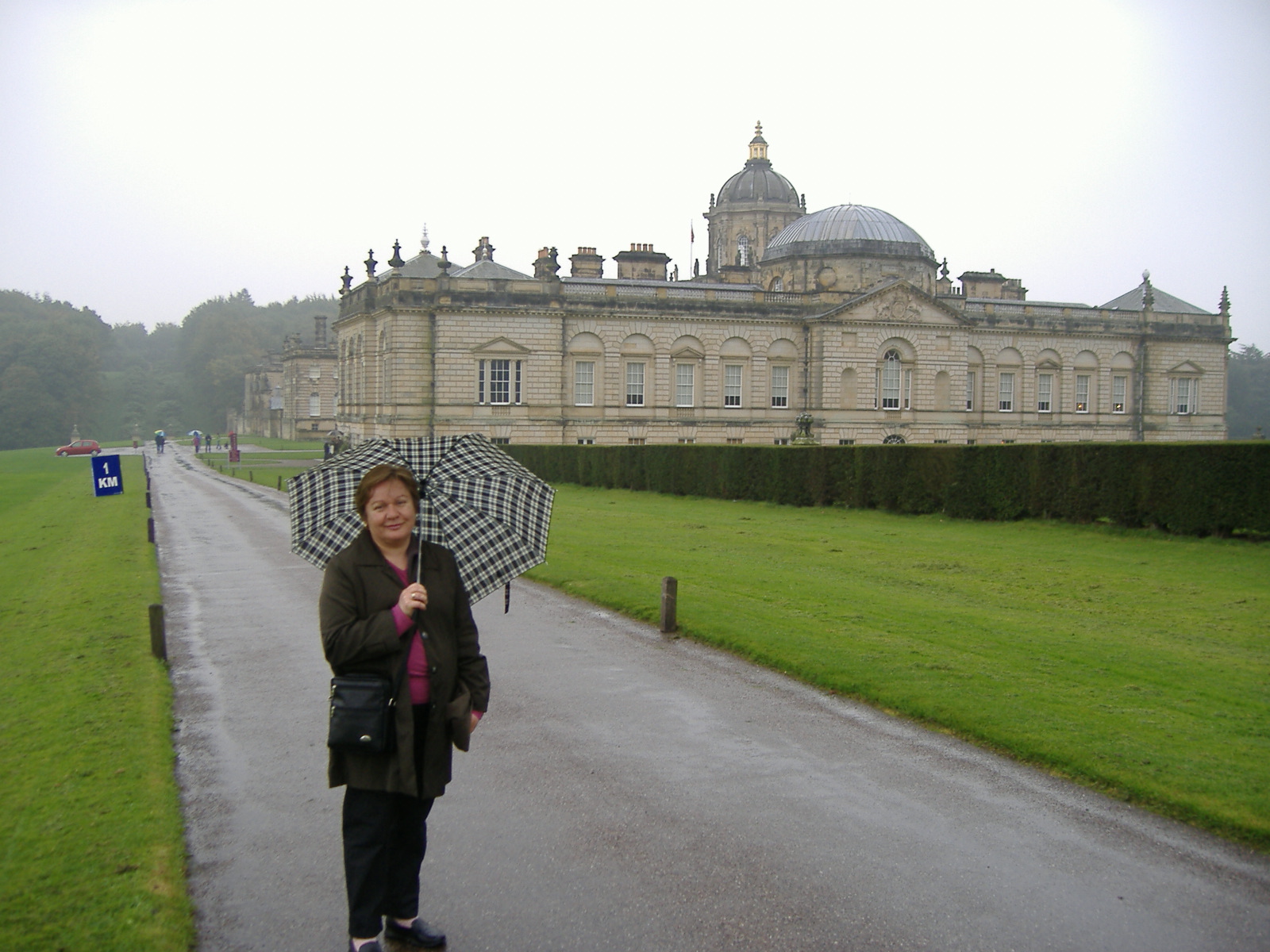
In its favour, the Brideshead scenes in the movie were shot at Castle Howard, as was the case with the mini-series.  Interestingly, Waugh (in the preface to the 1959 edition of the book) broods that, when the book was written in 1944, it seemed that the ancestral seats were "doomed to decay and spoliation like the monasteries of the 16th century".   Writing in 1959, he said, "Brideshead today would be open to trippers, its treasures rearranged by expert hands and the fabric better maintained than it was by Lord Marchmain".  Fast forward to the present, and (taking the liberty of substituting Castle Howard in Yorkshire for Brideshead, said to be in Wiltshire)  his words have turned out to be self-fulfilling.   Here are some images (obviously not as good as those in the movie or the mini-series!)

06 November 2011

Lovesong

I recently read Lovesong, by Alex Miller.  This is the story of Sabiha, who is Tunisian,  and John who is an Australian teacher travelling in Europe.   Their lives change when he stumbles into her cafe in a working class part of Paris.  Yes, they marry, but there is no child, which leads to a series of events, tragic in parts.   Ultimately John tells the story to Ken, an aging writer, when he, Sabiha and their daughter are living in Carlton.  The book also gives glimpses of Ken's own story.
I admit that this is not the sort of book that would usually appeal to me, but I found it well written and it certainly drew me in and left me with food for thought.

23 October 2011

The Big Fella

My literary diet largely consists of detective stories and travel books.  More about that some other time.  However, I do try and diversify occasionally.   One recent foray was to read "The Big Fella", which is the story of BHP Billiton by Peter Thompson and Robert Macklin, published in 2009.
While the book deals with the entire history of BHP Billiton, I found that the insights given by the book  into the events of recent years to be very interesting.  Since arriving in the late 1980s at the law firm which had just finished acting for Robert Holmes à Court, I've watched BHP Billiton, although of course strictly from from the outside.  More particularly, I've had the privilege of being involved in a small way in a number of the transactions over the last decade and a half which are described in the book, and so it was interesting to read the book's "take" on  these.    The authors rely greatly on detailed interviews with many of the people involved, and there are liberal quotations from these.  As a result, the book is quite easy to read, but as a result of the focus being on the attitude of the individuals concerned to the various events, it is in parts a little disjointed if the reader is seeking to understand the underlying transaction.    However, in fairness there are obviously compromises that have to be made when portraying events which have many facets.

22 October 2011

Concert night!

We attended the combined Melbourrne Savage Club/Lyceum Club concert recently.  The theme (which was followed somewhat loosely) was bike riding, with mentions of Cadel Evans and others.  In the company of some good friends, the result was a great night of music and comedy, with plenty to eat and drink, too!   It's really amazing what how much talent often exists among people you see sometimes quite regularly, but because it's underneath the surface, you don't realise it's there.   And it's very impressive that people have the courage to get up on the stage!
The image below is of the social room at the Savage Club, but the furniture was re-arranged for the concert.

09 October 2011

Clybourne Park

We went to see the Melbourne Theatre Company production of Clybourne Park.  This relates to events (50 years apart) in the same house in an inner suburb of a US city.   In 1959, the couple who are selling are confronted by white neighbours who don't want the house sold of a black family.   In 2009, black neighbours object to the house being demolished by a gentrifying white couple.   The issues of race and real estate remain constant, but the time gap of 50 years has made a big difference to the way in which the issues are expressed.
The play includes some very funny lines and addresses the underlying themes in an intelligent and credible way.  We certainly enjoyed it,  notwithstanding a couple of minor reservations on my part (Is bad taste found so much more often in white people?   Did the  "jokes" towards the end have to be quite so offensive?)