14 December 2011

The Importance of being Earnest

One reviewer says that Oscar Wilde's most delightful play is "still fresh after 115 years".    I read somewhere that it's one of the funniest things ever written. Well, we saw this a little while back and thought Melbourne Theatre Company's production was great.  Of course, the language and wit are Oscar Wilde's, but modern audiences still enjoy this take on Victorian-era manners, especially when the production is as good as this one.  The reviews speak highly of Geoffrey Rush's performance as Lady Bracknell, but he was strongly supported by the entire cast.  In my opinion, Bob Hornery's  role of both butlers deserves particular mention.
The performance is in the Sumner Theatre, which is smaller than the Playhouse, and I read that the season is virtually sold-out.  Perhaps because so much depends on the facial expressions and other details (such as the consumption of cucumber sandwiches and muffins!), the smaller venue was considered to be more appropriate in that it enables the audience to appreciate some of the finer points.

13 December 2011

Spirit of Tasmania (2)

We returned to Melbourne overnight on the Spirit of Tasmania (actually, "Spirit of Tasmania 1", because there are 2 vessels which I understand are almost identical, being "S of T 1" and "S of T 2").   Again, there was a long wait to board at Devonport, but I am now clearer why this is so.   The information provided to passengers is that "boarding" commences 2½ hours before departure.    But this isn't correct.   Apparently "check-in" commences at that time, but "boarding" doesn't occur until 1 hour before departure (although I'm not sure whether this may depend on the number of vehicles).   Hence, if you "check-in" early, you're held in the "departure lounge" - in this case, in your car in a queue.   It's a pity that passengers aren't made aware of this but I suppose the organisation  wants to spread the load.
If we ever travel again by the "Spirit" I would certainly prefer to spend the time waiting for departure in a more pleasant environment than sitting in a car in a queue.
Earlier in the day, we had visited the Don River Railway (more to follow on this!) and spent some time in Devonport.
There was more "movement" on the trip back, and neither of us slept very well.    But at least there's no quarantine check as you leave the vessel in Melbourne (unlike Tasmania), so we got home quickly .
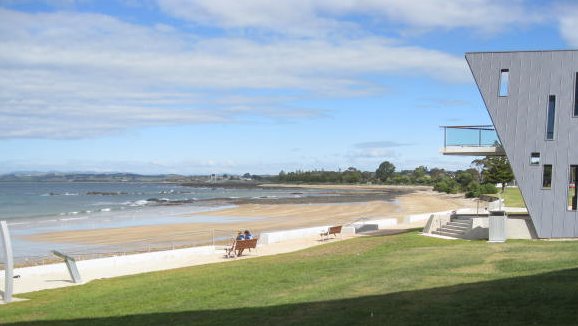
 Beach at Devonport
Ferry at Devonport

12 December 2011

Penguin Market and Ghost Rock winery

Sunday 11 December - After a leisurely breakfast we set out for Penguin, in search of the Sunday market. Although Penguin is over 50 kms away, we made good time because, once we hit the main highway, it was dual carriageway the whole way with a 110 kph speed limit for the most part. The market was quite good, complete with a country and western band in the market square. The music seemed to be in line with the locals' taste.
Penguin certainly trades on its name – see the image below.
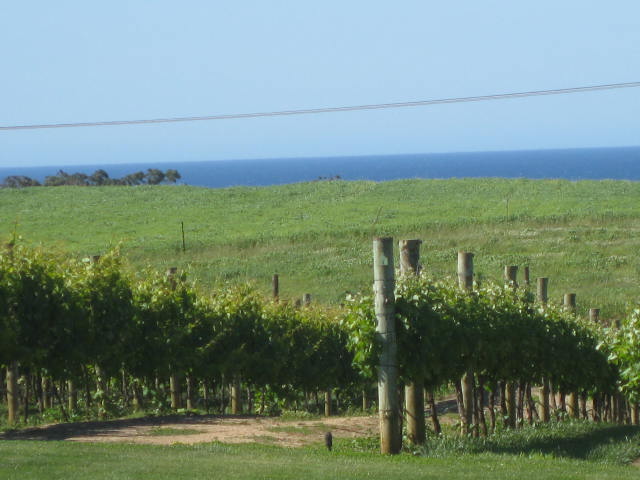
We were on our way back to our accommodation (via the coastal route to Ulverstone, which runs literally next to the sea) by mid-afternoon, so had time to stop in at the nearby Ghost Rock winery. We sat on the deck and enjoyed a glass of the local wine overlooking the vines with Bass Strait in the distance.
Dinner was less formal than the previous night, at the local golf club. However, it was perfectly adequate.
We're the only guests at Hawley House tonight, and chanced on the operators on our return. Hawley House is larger than a B&B, but when you're the only guests, B&B etiquette prevails. This involves reporting on what one has had done during the day and providing feedback on the recommendations that have been provided to you in the morning (in our case, the visit to Penguin Market).


View from Ghost Rock winery
         

11 December 2011

Hawley House

A reflection on activities on Saturday 10 December – It doesn't look very far on the map, but the trip from Geeveston to Hawley Beach was quite a drive, especially the last 50 kms or so over secondary roads (sealed but often relatively narrow with quite a few hills and bends). We had lunch at Ross, which is a pleasant town with various “antique” markets and similar activities.
We visited Hawley House in February 2008, so this is a re-visit. Last time, the area was affected by drought but this time it looks much better. There are lots of flowers in the gardens and the wetlands have adequate water.  The frogs croak all the time (good to hear).
There is a group of 24 here, and we're the only others.    The group ate in the dining room, and dinner for us was set up in the lounge room, by the window. We felt quite aristocratic, being waited on separately. The dinner was good, too. And there's a good wi-fi connection.
 Huon Estuary
 
Hawley House/wetlands
Hawley Beach (just in front of Hawley House)

10 December 2011

Reflections on the Tasmanian Deep South

Thoughts for Friday 9 December - Sitting in the lounge room at the B&B with a glass of wine and listening to a shower of rain on the metal roof, things seem pretty good. There's platypus in the stream at the bottom of the garden. Only catch? No internet! I sometimes get 1 bar reception on my Telstra mobile (but not even that further south), but the Vodafone wireless modem obviously doesn't get a thing. One of the cafes in town has a sign stating that it's an internet cafe, but on enquiry, no guarantees existed that it would work and besides you had to have your dinner there and pay $5. We passed on that one.
I wanted to go to the Ida Bay railway, but of course the day we're here is the one day in the week when it doesn't operate. So we went to the Hastings Caves instead, which were really good. The guide was very informative and the caves were excellent.
I tossed up about driving to Cockle Creek which is as far south as you can drive in Australia, but the additional 20 kms there on a gravel road (& 20 kms back) seemed a lot to go through for a fleeting photo opportunity. So we went looking for a cappuccino at Southport. Ummmm, lovely beach, boat ramp and a phone box, but definitely no coffee shops. Apparently the only option is the 60s style pub/general store/holiday park/petrol pump (most southerly in Australia) a couple of kms inland. Again, we passed, and retreated to the aforesaid glass of wine and creature comforts of the B&B.
Dinner was at a restaurant in nearly Franklin (called “Petty Sessions”, in a former court house). Again, we were impressed by the standard of the offering. 


Beach at Southport

Richmond and B&B etiquette

This is the post for Thursday 8 December coz in Tassie you don't have to go far to be out of internet range! Hence, I'm a couple of days in arrears.

Richmond is historic and cute, with all that that entails (hint – think souvenirs!). I thought (after consulting the map) that we'd get there from Hobart via Risdon Vale. However, this wasn't such a good idea, because the map didn't make it clear that this route involves a long and winding climb over a big hill and down the other side. Still, we got there satisfactorily (with the aid of the GPS) and had a nice coffee and later on some lunch.
I visited the Old Hobart Town model village. Although not very big, it does have a lot of detail and claims to be authentic.
Moving on to the Huon region, our accommodation was a B&B. Over the years, we've stayed in many forms of accommodation, including guest houses that have many of the characteristics of a B&B. But this is the first time we've stayed at a B&B in the “classic” sense of the expression, namely about 4 rooms and operated by a couple who provide breakfast cooked to order in the kitchen adjoining the dining area. I've read that an important issue is for the hosts to get the balance right between being friendly and helpful versus intruding on the guests' privacy. The people who run this place seem to have got the correct balance, and on top of that, provide a great breakfast!
We're still working out a couple of the finer points re B&B etiquette. The main issue we're grappling with is, when do you lock your room? We don't think you're supposed to do so when you're out of the room but still on the property (having breakfast or sitting in the lounge room). However, we did lock our room when we went out for dinner, but not when we went out during the day (on the basis that access to our room would be needed to service it). However, since we're newcomers to B&B'ing, perhaps there are things we still need to learn.
We had dinner in the hotel a couple of kilometres down the road. Certainly, it had a “country pub” atmosphere, but the food was really good. We recently went to Pure South (at Southbank) who do “Tasmanian” food. Well, this pub was right up there with PS. Perhaps not quite so much finesse, but the quality was there and the prices about 60% of Pure South!
Images are (1) detail from model village and (2) B&B at Geeveston.


08 December 2011

MONA

Hobart's privately-owned Museum of Old and New Art is provocative so we were well prepared for our visit. First, the enjoyable aspects. The space in which the exhibits are displayed is indeed spectacular. It's dug into the solid rock, and the display areas and walkways are quite amazing. I quite liked a number of the exhibits.  For example, there's a device that uses drops of water to form words (see image below).   However,  there were others that I struggled with. Is a heap of coal “art”?

Many of the items have sexual themes, sometimes quite challenging. Even a couple of the exhibits that seemed to be innocent enough turned out to have sexual overtones when you read the description on the electronic guide that you're given. Ultimately these types of themes are are matter of personal preference, even if some of the treatments seem somewhat gratuitous. However , this is what MONA is known for, so it's hardly cause for complaint.

But (as no doubt intended) I was definitely confronted by a number of the items. In particular, I found disturbing the displays involving various forms of mutilation and cruelty, some very specific. True, there aren't a lot of these, but even so, the question again arises as to whether such things really are “art”? No doubt terrible things do occur in our world, but personally I think there are better ways of dealing with them than via art. I think there is a real risk that the result of displays such as these is that we will be de-sensitised.

We tossed up whether to take the ferry up the river to MONA. In fact, this is a good option, although you do have to decide in advance (when booking) how long you're going to stay. 2 or 3 hours for the museum plus some time for refreshments (perhaps in the cafe) seemed to us to be plenty of time. If, in addition to MONA, you were going to eat in the up-market restaurant (separate from MONA, but on-site), you'd need more time. Another option would be to go to the wine bar (again outside MONA) rather than eat in the cafe.


07 December 2011

The Central Plateau

We took the Great Lake route from Devonport. This climbs out of Deloraine through some very impressive scenery before passing through the Central Plateau Conservation area. It runs alongside the Great Lake and crosses the high plateau. We cut across to the Derwent Valley and got to New Norfolk in time for lunch.   And, by the way, who needs to go to Afghanistan to get their fix of poppies?    We were checked into our Hobart hotel by early afternoon. This gave us time for an afternoon walk around Constitution Dock and for a drink in Salamanca Square.  Later we ate at a restaurant overlooking the docks.


06 December 2011

The Spirit of Tasmania

Well, it was nearly an hour and a half from the time we arrived at the security point (which only took a couple of minutes to clear) until we were getting out of our car on the ferry. That is, 90 minutes sitting in various queues on Station Pier. This was notwithstanding the fact that we arrived just a few minutes after boarding was scheduled to begin. I can't work out what caused the delay. The vehicles would move slightly forward, then pause. Even in the final holding area before driving on to the ferry, there were times when nothing seemed to happen for minutes on end. I accept that loading a ferry may have its complications, but internally the vessel is well fitted out so that different types of vehicles can be directed to appropriate areas. Compared with our experience (admittedly some time back) on the Queenscliff/Sorrento ferry, it was just unbelievable and very frustrating, especially given that there seemed to be staff everywhere.  Is it just my pre-conceived notion, or is the level of staffing a fact of life in the Australian maritime industry? I wonder how by how much the Australian taxpayer is subsidising this operation? Clue – our invoice states that the subsidy on the cost of our car is $388.  

On board, there didn't seem to be anything like a full load of passengers, and so there was plenty of room in the lounge areas. There were a couple of school groups. No, they didn't misbehave but of course they were excited and a bit rowdy. I heard one group being told off. I suppose the teaching staff know best but I thought it was a bit tough!.

We were happy with our internal cabin and slept well, gently rocked by the movement of the boat. The food for purchase was fairly plain, pub-like I guess you could say, and in the same price range. There's also an upmarket dining area, but it is expensive ($56 for 2 courses, $64 for 3).

There was nearly full moon, but even so, I couldn't see much going down the Bay. I always enjoy going through the Heads, and got a great view looking backwards at the Queenscliff leading lights.

Disembarkation at Devonport wasn't too painful, although the order in which you board the vessel has nothing to do with the order in which you get off. There was quite a queue for the Tasmanian quarantine check, but I suppose they're just doing the job.

We had breakfast at Deloraine then drove down the Lake Highway past the Great Lake and through the Central Plateau Conservation Area. Fantastic scenery. I have only done this route once before and had forgotten how great it is. More about this later. Here are some images as we left Melbourne.


.....

05 December 2011

Tasmania

We're off later today on the ferry to Tasmania.   Although we've been on the Spirit of Tasmania before, previously we've travelled on daylight crossings.  Although these were more than satisfactory - and good value - daylight crossings only operate between Christmas and Easter.    So this time, we're going overnight.  We'll let you know how it all works out.
I'm taking my netbook, but roaming coverage in Tasmania is often said to be not good and Vodafone who I use generally have the least coverage.  That said, in their defence, I've found that their availability has met my needs in the past, in various of capital cities, the Blue Mountains, the Surf Coast and the Sunshine Coast.  On top of that, their prepaid plan is pretty good value, too.    We'll see how we go in Tassie!

04 December 2011

The Grand

We ate at The Grand in Burnley Street, Richmond the other night. The night started satisfactorily because we found a parking space without too much trouble. It was pleasant food in a nice room (even though it’s part of a pub!). It claims to be Italian but we're not sure if it's "modern" as claimed.  But it does seem to be authentic (can it be authentic and modern at the same time?) although we’re only amateurs at discerning that sort of thing. Some of the dishes were terrific, such as the asparagus spears with fried egg for entree. However, for mains, the grilled pork cutlet and roast duck with orange & juniper sauce were both fine, but we thought that each lacked something of a “spark” (we wondered if this was in the cause of authenticity).

The service was initially cool and detached, but picked up markedly when it was discovered that there was a linguistic affinity between one of the wait-staff (who was born in Bosnia) and several of our group.


03 December 2011

Myki

On the whole, I don't have any real issues with Myki, although I am concerned about the absence of any announcement to date regarding single trip or other form of short term tickets after Metcard ceases to operate.
But I have been interested to see the proliferation of Myki readers at our local station. At one location, we now have 6 (although only 2 are actually working).    This is in addition to 2 Metcard readers.   Perhaps this is to avoid queues when the response time is slow, which sometimes occurs. Does it say something about the system that it's easier to instal more readers than to improve response times?


02 December 2011

The helpful man from Windows

We had just had lunch and I had had a glass of wine (but it was a small one) when the phone rang.   After the customary period of silence (during which the automatic dialer forwards the call to a real person), we were greeted by a helpful sounding gentleman.  He said he was calling from "Windows" because they had detected we had a problem with our computer.   He even knew our name (scary).
Given the sub-continent accent, the poor quality of the phone line and the highly improbable scenario of anyone from Microsoft actually volunteering to help anyone (and certainly not for free) - plus the fact that this scam has been around for a long time! - I was tempted to hang up.   But perhaps the wine kicked in, and I remembered that my aunt (who is well into her 80s) had told us she had received a similar call and had quite a lengthy discussion with the caller before she revealed that she didn't have a computer at all!
So I informed the caller that, yes, we were in fact having problems with the computer and I was glad that help was now at hand.  I offered a credit card number, but no, this wasn't necessary.  However, he wanted me to turn the computer on.  I said that I was having difficulty getting it to boot up (stretching the truth a little, since the reason it wasn't booting was that I hadn't turned it on!), and I was so glad that he was here to help.  He offered various suggestions, all with the objective in mind of giving him remote access to the computer and hence the ability to take control of it.   We spent a little time to-ing and fro-ing about my worries that I had a virus and  I wondered how long this would last.  His tenaciousness was greater than mine, and I gave up before he did and finally told him that we were wasting each other's time.  I think this may have come as something of a surprise to him, which perhaps says something for the naivety of the people who get involved in assisting with these scams.
 

01 December 2011

Horseshoe Curve

I mentioned Altoona recently.    Altoona doesn't have a lot of charms but it was the location of the main workshops for the great Penn Railway and has an interesting railway museum (more about this some other time).    It's also close to Horseshoe Curve, which is where the railway climbs up to cross the Alleghenys.  Building it was a great engineering feat in the 1850s.   It is so important that the Nazis attempted to sabotage it during World War II.    The curve goes through 220 degrees and there are more than 50 trains daily on the triple-track mainline, most of them being very long freight trains.  The trains climb slowly up the curve, and the ones going in the downward direction are pretty sedate, too.   It's a popular tourist attraction, and is accessible via a visitors centre and funicular running to a small park close to the rail tracks.   Unfortunately by the time we visited it, steam locomotives had long since ceased to run on this line, but the diesels were impressive nevertheless!


30 November 2011

The Picador Book of Crime Writing

I took this anthology edited by Michael Diblin from the library shelf on a whim. I often read detective stories but this wasn't quite what I expected.
I was encouraged by the opening statement in the Introduction that it is dedicated "to the proposition that good crime writing is good writing".   A little further on, it is said that when describing a man coming through a door with a gun in his hand, you don't need half a page describing the door!   This statement resonated with me, as did the statement that "...for every writer who pads out a two-hundred -page detective story to twice that length with decorative frills and flounces there are ten whose work might have been written not just on but by a word processor".
Hmm, I have to say that I can think of prize-winning authors (not of detective stories) whose work seems to me sometimes to come into this category.   Diblin appears to agree, as he says "good crime writing has nothing in common with 'fine writing'".   But I'm definitely not an author and certainly not qualified to judge literary merit, so I won't pursue this angle (surely he wouldn't reach the conclusion that 'fine writing' isn't necessarily 'good writing'....?)!
Back to the anthology, it's a collection of more than 50 short stories, by authors ranging from Ernest Hemingway, Oscar Wilde  and C P Snow through to people I hadn't heard of.  Some are extracts from longer works, and some were written as short stories.  If one's view of traditional "crime" writing is about solving crimes (that is "detective stories"), this isn't a book in the traditional mode.  Many stories are about the committing of a murder! In a few, all the circumstances for the commission of a crime exist, but none actually takes place.  There are some police stories, including one where a gang who have committed a robbery is apprehended, based on information provided by an informer.   There are a couple of stories about hangings.   There's a bizarre story about a bomb disposal team deliberately allowing the bomb planted on a criminal to explode.
It's all unpredictable.   Certainly the variety of scenarios covered in itself kept my attention.